How this works
A turn is a position, not a period of time. Turn 1 is the start, turn 2 shows where everyone stands after moving — the arrows in between are drawn by the board itself. + Turn adds the next position; it starts as a copy of the previous one, so you only move what actually moves.
Knocked out means: from this turn on the brawler is out. They stay on their square, crossed out, because that is the point — where they went down. In the turns before, they are still alive. When you tap, the board asks by whom: the choice is the brawlers on the other side who are still standing this turn. A red line then connects the two — and during playback it flashes as the victim goes down. If it is not settled who landed the hit, pick not decided; then they fall without a line.
Attack is the other question: not who landed the hit, but who should go for whom. A figure's menu has attacks ⌖ — the map then goes dark, your own side steps back, and the enemies still standing this turn start to pulse: just tap the one who is meant to go down. So you pick on the board, not from a list, because on the board you can already see who you mean. Any other click — your own figure, an empty tile, the ✕ at the top — means "never mind", and Escape does the same. A thin dashed line in the attacker's colour then runs to a ring around the target — the ring carries the message, the line only says who it comes from. That way you see at a glance when two are meant to focus the same brawler. An attack applies to its turn only, not the ones after. And if it works out — the enemy really is knocked out that turn — the planned line disappears: the red one stands there instead. During playback the attack happens instead of just sitting there: everyone moves first, then the dots fly, the mark snaps in and whoever was hit flinches. Turns with a fight in them stay on screen longer than turns where people only walk.
The clock is optional. Switch it on under … — it then starts with the time a match in this mode actually runs (measured from the battles themselves, not made up), every turn sits fifteen seconds later, and the time shows in the top right of the map and under every turn number. You change it in the field next to it — "2:15", "2.15" or just "135", all the same; enter one and the empty turns behind it follow. During playback the pacing follows it: five seconds of play are a brief moment, forty are half a map. Switching it off again works the same way, and then it is gone entirely. From the draft helper, "Take it to the board" brings you straight here with all six already placed.
Variants are for what a plan otherwise cannot say: "if they take the middle, things run differently from turn 3". Under … you will find Variant from turn N ⑂; give it a name — ideally the condition it applies under — and from there you build a second line. Tabs then appear above the turn chain to switch between the lines; During playback you do not have to stop yourself: at the fork the plan holds still and asks how it goes on — the variant names stand there as the answers, you tap one, and from the next turn on that line runs. Nothing jumps back to the start; the start was already on screen. If the main line stops at the fork, the other answer reads Then this is the end. The turns before the split are dimmed: both lines share them, so what you change there counts for all of them. Branching always starts from the main line, and there are never more than three variants — a plan with five if-then branches is no longer one that anyone reads before a match.
The speech bubble is where you put what someone is up to: a figure's menu has says something 💬, above it the question "What does Nori do in this turn?", and whatever you type hangs off their portrait right away — "I wait here until my super is up". No names needed: the portrait next to it already says who is talking. A bubble belongs to its turn only and is not copied into the next one — a sentence is an action, not a state. During playback it appears once everyone has arrived, and the turn stays on screen a little longer for it. Keep it short: anything that does not fit in three lines covers up the very position it explains.
Respawn appears in the menu as soon as someone is knocked out: they are alive again and stand at the back on their own spawn — where the game puts them too, not where they went down. A pale ring marks the spot. Next to it is not knocked out after all, for the misclick: that one leaves them where they are. In knockout there is no respawn entry — nobody comes back there until the round is over, and a board that offered it would be a board that does not know the mode.
The ball appears in ball modes as its own button next to the two sides. It belongs to no team, is dragged like everything else, and its dashed line between two turns is then a pass or a shot. The lightning bolt on a brawler means "super is charged" — from this turn on, until you take it away again. Both are in the menu that opens when you tap a figure.
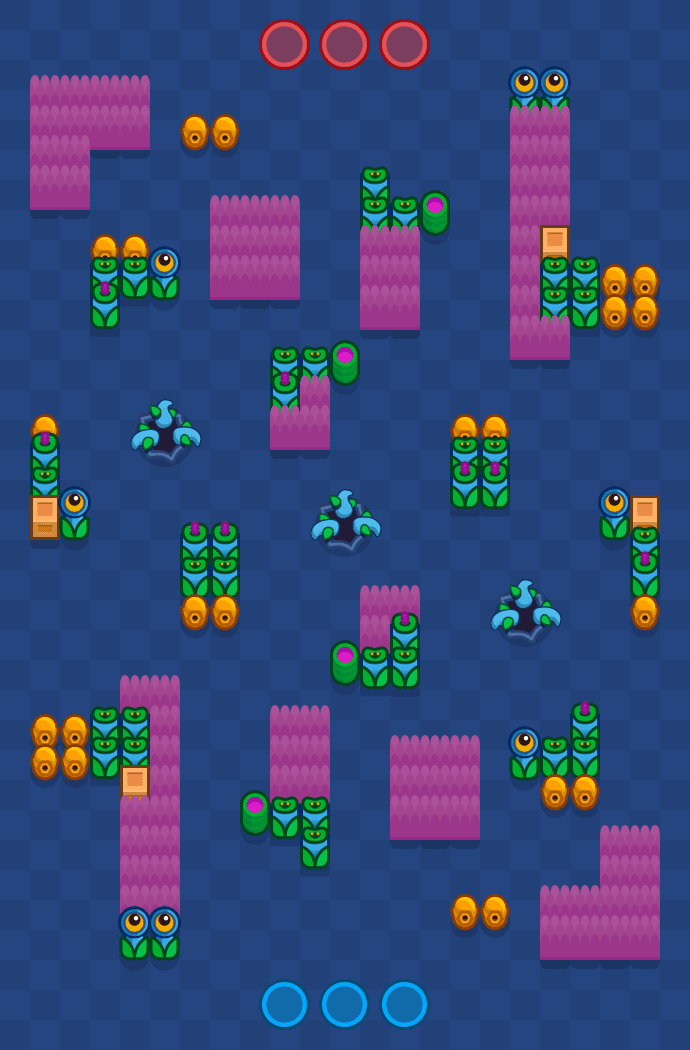
Blasting walls away is the brick button under the board, next to Play. With it on, every tap on the map clears whatever stands there — a crate, a wall, a bush — and the ground underneath appears as if nothing had ever been there. Drag to clear several tiles at once, since a crate is two of them and a wall four. It applies from the turn you do it in: if the wall is still up in turn 1 and goes down in turn 2, tap it in turn 2 — before that it stands, after that it is gone, exactly like in a match. Tapping again means "it does not fall after all", and that counts for the whole plan: a wall that comes back does not exist. Two more things: a block often overhangs downwards — its edge and shadow sit in the tile below, and that one has to go too, otherwise a strip stays behind. And in a variant other walls fall than in the main line — "if Brock opens up the wall" is exactly that kind of if.
Nothing is stored. The whole plan lives in the link — which is why there is no expiry date here either:
as long as someone has the link, they have the plan. The server never sees it, because browsers do not send the
part of the address after the #. Only the bubbles are kept short, otherwise the link gets
unwieldy.
There is one exception, and you press it yourself: Submit sends this one plan to the server so that I can
look at it. What is stored in that case is set out on the privacy page.
The grid is the map's own tiles. Figures snap to it so that two plans of the same map stay comparable — and because half a tile is not a position in the game.